Monday, August 13, 2012

It's magical


My color theory teacher's favorite saying was, “It’s magical!” She used it to describe optical illusions, color in general, and the universe. 


Megan made this. It's a classic example of crystallographic composition.
During the first week I just painted a lot of squares in color and black and white. Our first project was to take a color image and paint it in black and white to practice training our eyes to match hues to their intensity and saturation in the achromatic scale. I had to trace the image and transfer it to another piece of paper and then paint it by hand. I hated this project.


Random side note. We learned really useful color trivia, such as: Germans like their egg yolks darker, so they feed their chickens marigold petals and paprika, and that fleas in Louis XVI’s palace drove women crazy, but when one of Marie Antoinette’s favorite shades was named puce (French for “flea”) the name stuck and triggered a trend that inspired dyers to produce hues with names like “belly of flea,” “thigh of flea,” and “blushing flea.”

And then we talked about logo design and why designers use certain colors. We could pick any logo we wanted and reinterpret the original color usage to convey new meaning, and then somehow improve upon the original color. I chose the little Utz Girl who appears on bags of chips, pretzels, cheese puffs (a New England thing) because she started copying my haircut in 1921. 
The original. Dated. Clownish. Geisha.
achromatic-no color associations at all, loses some iconic charm of the original.
monochromatic-makes it look retro, more graphic.
complementary-complements enhance/intensify each other and call to mind sports teams. She looks like a Bronco's cheerleader.
polychromatic-this scheme makes things look childlike, and makes me look racist.
analogous-makes her look like Barbie's cousin.
split complement-yellow green, blue green, red orange. This makes her look like the Jolly Green Giant's adopted child.
attempt to improve original-updated color on cheeks to look youthful and less old fashioned and washed out than the original. Yellow stimulates hunger.

Part of the class work was to keep a color journal where we collected samples of real world color schemes in printed material, ads, photos, paintings, etc. We had to look for all the major color schemes/relationships: primary, triadic, secondary, tertiary, complementary, achromatic, monochromatic, polychromatic, split-complement, analogous, etc.

For one section of the color journal was to observe an object in nature and paint the colors we saw at different parts of the day. We had to paint the subject at dawn, at noon, at dusk, and at night. I hated this project.

We talked about color psychology--how writing with blue pen ink and painting your room blue stimulates creativity and how red and yellow stimulate appetites so they often appear in restaurants, etc. All of this plays a huge factor in determining the names of every paint color you can imagine. For example, the beginning of the recession marked designers’ renewed efforts to capture consumers’ attention by distinguishing their brands with names that tell stories, recall memories, or evoke emotions. So instead of calling beige "beige," companies go for names like toasted bagel because who wants a beige kitchen? A cooking space accented in toasted bagel is supposedly so much homier. Martha Stewart has paint with colors called Darkening Sky and Tempest instead of gray and dark gray. Benjamin Moore has Stormy Sky. Pantone has Turbulence and Tornado. The British company, Farrow & Ball, offers Dead Salmon (it looks like taupe). We read an article about a lady who works for Sherwin-Williams and it’s her job to name all their paint colors. Once she was assigned to finalize 1,000 new paint names (they rename paint every 10 years). It took six years. The naming process from start to finish only took 1 ½ to 2 years, but it took longer to do research and collect ideas from reading magazines, from traveling, and from day to day living to search for terms relevant to today’s environment. So of course, computer-speak made it into the final lists—she gave a range of grays names like Chat Room, Virtual Taupe, Network Gray, Online. Her personal favorite color is called Impetuous. It’s a 21st-century chartreuse inspired by a color that was popular in the 50s. I want her job.

We talked about color usage and had to choose a subject in any medium and recreate the color in the scene so that it was used to convey different ideas each time. I found a photo of Jane Eyre and a scary English forest and manipulated them on PhotoShop.

arbitrary: colors appear to be random, objects are colored differently than they occur naturally
emotional: black recalls grief/mourning for all the deaths Jane witnessed as a young girl.
complementary: blue and orange might be my favorite complements
realistic: these are the original photos but I forgot to paint the tree brown and the grass green and creepy Mr. Rochester's face a flesh color
symbolic: Jane got locked in a red room as a punishment when she was little. The red room symbolizes anxiety, trauma, suffering, loss of innocence, her Aunt Reed "infantalizing Jane and forcing her back into the womb to be born again with a new attitude..."
My favorite assignment was our color function project. We discussed the four functions of color in nature: color is used in nature for warning, camouflage, mimicry, and attraction. We chose a subject to paint in four different settings with each one demonstrating the four different uses of color.  

warning
camouflage
mimicry
attraction

Friday, August 10, 2012

How to make summer disappear in two seconds


In May I met a teacher who confirmed my growing suspicions about the imbeciles who run the RI State Office of Education. When I couldn’t get a job teaching middle or high school kids how to write coherent paragraphs and revive the art of putting periods at the end of their sentences, I thought something was wrong with me, and I may or may not have been a little bit depressed for a while. On Tuesdays and Thursdays when I wasn’t at URI, I horbgorbled around our apartment in my pajamas without brushing my teeth or fixing my hair and I made multiple batches of cupcakes and ate them all myself. I stalked people on Facebook. I consumed entire boxes of Kleenex and drenched our throw pillows in soggy tears. I even read the news for a while. I couldn’t figure out what my problem was. I was applying to schools that posted ads like this: “Seven English teachers needed, no experience necessary, bachelor’s degree preferred. Convicted felons discouraged from submitting applications.” What was wrong with me?

And then in May after a training meeting at URI, I met a kindred soul. But her story was full of more intrigue than mine. She was the AP teacher at an expensive boys Catholic school, which happens to be across the street from our house, and to which I also applied. She fell madly in love with the English department chair and they decided to get married. He’d been divorced and when the headmaster (they still have those here) found out they were engaged they were uninvited to return the following year because he wanted to remarry after having a divorce, and divorce alone = unalterable impending doom in the Catholic worldview. Or something like that. So my newfound friend and her husband sought employment elsewhere. They each had about 10,000 years of experience and he had a principal’s license (even though he wasn’t an education major; he did alternative route to licensure). Every school he applied to said, “Sorry. You have to go back to college for four years and get your official teaching degree like everyone else. Then you can reapply. When my friend applied for jobs they told her they couldn’t hire her because she had a master’s degree and too much experience and they couldn’t afford her. That explained everything! I cannot get a job in RI because I have a master’s degree. And a level II teaching certificate. And a reading endorsement. And teaching experience. And because I tried to be proactive and hand deliver my applications to several schools that advertised openings so I could introduce myself to the principals. That sort of behavior is frowned upon here.

So maybe I gave up my job search prematurely. I sort of quit looking in May, but I had the feeling that no matter how hard I tried, I wouldn't have found anything. There might have been openings at high schools in Providence with the sort of reputations that inspire front page news articles about how students beat up teachers and the teachers get sued for hitting back in self defense. I wasn't interested in those jobs.

I needed something else to do with all the extra time I would have after giving up on finding full time work. So one day while I was sitting at home staring at the wall after eating a dozen red velvet cupcakes I made to celebrate my belated half birthday, I remembered that I live in the great state of Rhode Island, home of the Rhode Island School of Design, and that such a renowned institution probably has summer classes. I thought, “I could learn how to paint!” so I poked around on their website to see if they had a watercolor class in June or July. They didn’t. But they do have an extensive continuing education department with certificate programs in everything from jewelry design to personal property valuation. I saw children’s book illustration on the list and signed up for the program—mainly because they accept everyone whether you can draw or not.

I signed up for three classes, which, as I soon discovered, is too many for summer. And because someone asked me to run a half marathon with them in September and I said yes because I didn’t have anything else to do at the time, my whole summer looked like this:  

I would get up in the morning and if I was lucky, I’d see Jesse before he left for work. And then I’d see him for five minutes after I got back from class. And then I’d fall asleep. It was a fun summer.

Sunday, June 10, 2012

The Relatives Came


May was Jason’s graduation month when relatives came from all over—Alaska, New Mexico, Florida, Rhode Island, New Hampshire, Pennsylvania. When does this ever happen in the history of the Shuster family? The last time my dad and his brother and sisters, Aunt Kathy, Aunt Nancy, and Uncle Geoff, were in the same house was probably in July 2001, the month their mom, my Grandma Helen Jane, died. Since then, their kids have done just about everything: they joined the wrestling team and managed to escape ringworm; were voted prom queens senior year; went to the Pratt Institute; did university lab research on bacteria with really long names nobody can pronounce; learned to play the clarinet; moved to China; got married; built a photography business; and grew out of Furbies and into those really tight pants that make it easier to walk with a quarter poised between your butt cheeks, because that’s what models feel like on the runway. So many lifetimes passed before we met again.

But that’s okay, because it gave us lots to talk about. Like the ingenious pranks George used to play on the local policemen that should be written down in a book, and all the scientists Jason knows who believed faith and science are compatible, and why Dad felt compelled to stop at the grocery store, in the dark, on the way to Chipmunk Lodge to purchase a 2 lb brick of Cabot Premium Naturally Aged Cheddar Cheese and spray can whipped cream ("You can't get this stuff in Kotzebue!").

We spent graduation weekend tucked away at Chipmunk Lodge, having a family reunion. Not the kind where everyone wears matching t-shirts, but the kind where we woke to the smell of coffee brew and kitchen chatter about all the crazy relatives, punctuated by birdsong outside our windows. We fell asleep to midnight whisperings of people who stayed up late, after the flames died in the fire pit and we ate all the marshmallows, to watch stars that shine brighter in the North Country than anywhere else we’ve seen. Waking up and falling asleep to the rhythm of conversation reminded me that we’ve missed out on important things for so long.

The whole weekend made me remember all the ways I knew this family years ago. There were Thanksgivings in Albuquerque where we went bowling and walked into jewelry shops full of Nevada green turquoise carved by Navajo silversmiths and I could pick anything off the shelf if I wanted, but I chose the silver pendant with the jack-a-lope and wore it every day until it got lost in the move to Rhode Island and there will never be another like it, even if I go back to New Mexico to look for another one. There was the summer Aunt Kathy drove me to my interview at Dartmouth because Dad was recovering from surgery, and she said, “You deserve to go to a good school,” and we both wished I would get in so we could be only two hours away from each other instead of 4,000 miles. And I knew Aunt Nancy only from pictures, because we never took vacations to Florida, but I still have some of the things she sent in packages: the red rubber boots, a senior portrait of her daughter Esther, which still hangs in my bedroom at home, and Grandma Helen’s antique double-strand teal necklace. Meeting Sarah for the first time put a face to the name I’d heard from Dad’s stories—“You need to meet Sarah. She was a national soccer champion, a singer, and went to Rutgers”—and reminded me of the last time I saw her parents in 2003 when they drove from New Jersey to pick me up in Brooklyn and take me to The Waverly Inn in the West Village where the menu had braised rabbit and roasted Amish chickens and we sat in the back, near the massive tree that reached through the glass ceiling.

With as many of us as we could get in one place for a limited time only, we finally buried Grandma’s ashes at the Bethlehem Cemetery on Sunday, May 20th. Before Grandma died, she wrote a letter, to be read at her funeral, in which she said, “Welcome to my CELEBRATION!” making it clear that she knew that death is merely the end of a fraction of the “fixed lifespan” that God has for each of us, that death is a homecoming to the more abundant life that awaits because of the Savior’s sacrifice. I didn’t need any tissue until Jason played Leonard Cohen’s Hallelujah and then I was ruined by the time it was my turn to hold the blue box of ashes and say something, and by the time it came around to me, all I could think of was the year we lived at her house on Whitcomb Hill and she let us adopt a personable, and very skinny, cat from the animal shelter. Grandma let us have it, even though she was kind of allergic, and the cat liked Grandma best because she fed it a lot of cheese under the table, which is why the cat took on the appearance of a fuzzy brown basketball with legs and a tail.

The weekend was too short and we came back to more rain in Rhode Island. But I did two important things after we returned: 1) I used our wheat grinder for the first time in almost seven years; 2) I made lots of wheat bread and Dad took copious notes and promised to clean the kitchen in Kotzebue so he could find the bread hook, which nobody has seen in about ten years, so he can make his own bread.

Our house is quiet now and I’m trying to climb back into my other life while hoping that we’ll all see each other again before 2025.
 
Day 1: Graduation at UNH Campus
It's like the BYU Cougar...you just have to touch it, ride it, sit so it looks like it's patting you on the head...


That picture where there are two cameras and half of you are looking at one, while the other half is looking at the other...
Day 2: Picnic Day


You can't NOT go to NH and skip Chutter's
Don't leave home without it.
Later we hiked Mt. Agassiz
There is a lot of this in NH
And this...


Day 3: Last hike through the back of Chipmunk property. It's 90 degrees outside. Why am I wearing a sweater?!

Someone left a random trash can lying around...


The end.

Saturday, May 12, 2012

Monte Cristo Weekend


Last week we FINALLY went to some mansions in Newport. This is one of the Rhode Island things you have to do because you can. Taking the tours reminded me of when my brother got the Guiness World Records 2000 for Christmas and I stole it and flipped through random pages and found the world’s heaviest woman (700+ pounds) posing in a stars and stripes bikini, and the lady who had to build a special room in her house to accommodate over 5,000 pieces of soap, and I thought it was all a little bit excessive and wondered, “WHY?!” The mansions make you wonder the same thing.

But they’re fascinating, in an odd, Count of Monte Cristo way; the owners built them because they had more money than they knew what to do with. Example: one guy built a stone palace and gave it to his wife for her 39th birthday and then they divorced and she kept the house but refused to live in it, (to spite him?) and moved in down the street with her new husband, a friend of her ex. 

Anyway, the owners of the Newport mansions had eclectic taste, like Monte Cristo—except I imagine MC had more taste. Their houses were designed with furnishings built in France or purchased from other wealthy households, taken apart, shipped to America, and reassembled in Newport—my favorite was the massive painting of Aphrodite or Athena or some ancient someone that was cut out of its frame in Italy or France and glued to the ceiling in one of the Newport lady’s bedrooms so she could wake up with good feminine (or masculine) vibes every morning. They imported cipollino marble from Italy and built rooms with platinum in walls embedded with images of the Greek muses. Their houses tried to be what classy European aristocratic palaces were, but didn’t quite impress the owners of their overseas counterparts. What probably disgusted the European aristocracy most was that  owners of the Newport mansions had no noble pedigrees. Example: Cornelius Vanderbilt, the steamboat and railroad tycoon from New York, son of lowly Dutch immigrant, was thought to have been “modest” with his money and taught Sunday school. Which is why his summer cottage, called The Breakers—the 700 pound lady of the Newport mansions—only has 70 rooms and 750 doorknobs (or is it 700?).  

In these houses you bathed in solid marble tubs that had to be filled and drained several times before the water was tolerably warm; you had to change your clothes 7 times a day and wash everything after using it once; you had servants whose entire jobs might consist of doing laundry, or emptying chamber pots, or polishing shoe buckles, respectively; you ate in dining rooms with 75 pound chairs made of bronze and covered in gold leaf while staring at massive portraits of Louis XIV's fake hair and unnatural legs. And you paid a French chef $10,000 a year (in the 1890s) to make you dinner (called Service a la russe), and the dishes moved in and out so quickly that you didn't have time to digest anything:

1. Oysters
2. Choice of soup (clear or thick)
3. Salad
4. Fish
5. Sweetbreads (which aren't what they sound like)
6. Meat roast with vegetables
7. Pheasant or some other gamey thing with more salad
8. More salad
9. Pudding doused in cognac and set on fire
10. Ice cream shaped into the form of a turtle or George Washington's face
11. Cheese, biscuits, and butter
12. Bonbons
13. Coffee, liquor, sparkling water, cigars

Side note: before refrigerators, servants/kitchen staff had to cut big blocks of ice from the private lakes on the house grounds. Everything was kept on ice, and since the collecting of ice blocks was so labor intensive, serving ice cream was the sign of real wealth.

So, yeah, life was good. I guess. But ours is better because we can go to Wal-Mart in our pajamas and we have a friend who will make us ice Redbull sorbet in the shape of our favorite animals and deliver it to our door whenever we want.

The gate outside of The Breakers
A cool lamppost.
The back of The Breakers
I like how the nose looks sunburned.
This house was built for the Vanderbilt children behind The Breakers--so the little Vs would have somewhere to play after they got tired of sliding down the grand staircases on cookie sheets.
Jesse outside of Marble House.
The lady of Marble House was obsessed with the Orient, so they put this in her backyard.

Saturday, May 5, 2012

Safety First!

For those of you out there who might think that Sarita and I were not being responsible by playing on the train tracks as the picture at the top of our blog might suggest (i.e., Christian), I feel obligated to point out that the track we were on was not in use. You can see in the background the big red blot that is actually a sign put up in the tracks to signal discontinued use. So sleep easy my friends. Sarita and I only practice safe frivolity.

If you look real hard you can see someone on the tracks in the background.

I'm glad that we have such conscientiously safety-minded friends. For those of you who haven't yet learned your lesson not to play on train tracks, I leave you with a little lesson from Señor Gorey and The Gashlycrumb Tinies . . .

Tuesday, May 1, 2012

Last day


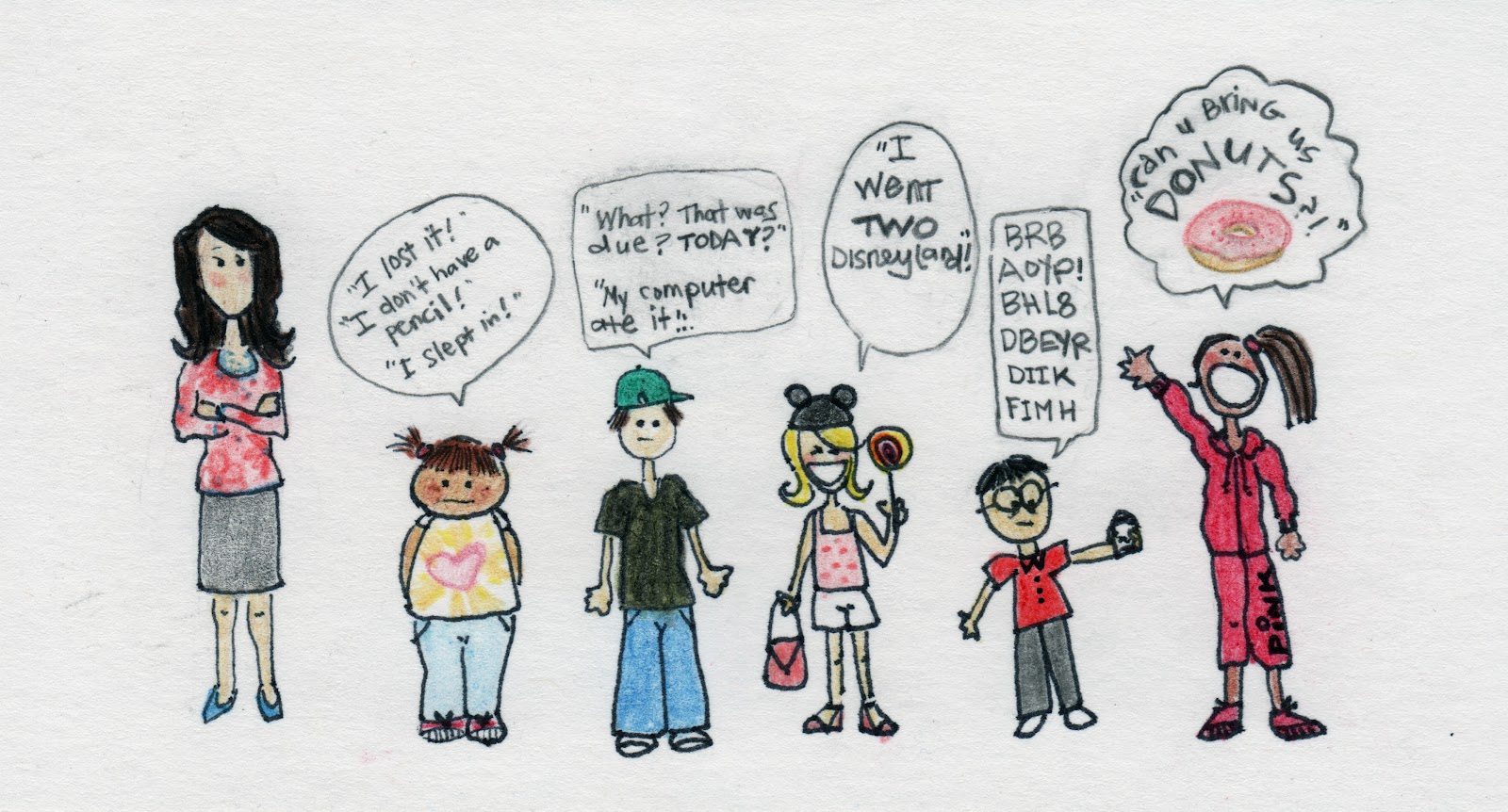
In seventh grade, the first day of school is the best: everyone comes to class on time and is seated with new shoes, unsharpened pencils, eager whispering, and class schedules folded neatly in their pockets before the bell rings. Everything is new and shiny and kept under control until they start this: 

But because they’re only 12, it’s easier to forgive them, even when their biology makes them go nuts from March to June. On their last day of school, they have to stack their desks, those ones with the chairs soldered to the tables, on top of each other, and someone always feels compelled to climb in between the desks once they’re stacked, even after I told them not to. The kid who climbs between the desks always gets his head stuck. And then they all want to run around in circles in the middle of the empty classroom. It’s a spectacular waste of time and tax dollars.

In my university universe, the last day is the best. It’s everyone’s favorite day and they all come on time and sit attentively, awaiting instructions. It’s my favorite day because it means the end of this:

Because they know better, it's harder to forgive them. I thought teaching college would be different. But average college freshmen are shockingly similar to 7th graders. When they get to college, they're just taller, hairier, and can sit still for longer periods of time. Their writing is a little better too.

The main difference, I suppose, is that when asked to describe themselves, seventh graders don’t have much to say, except that they like (or hate) Justin Bieber and their favorite food is Skittles. College students have slightly more interesting lives. This year, all the following described my students:

1.  I’m in the army
2.  I own a business with 20+ employees
3.  I was born in Belgium
4.  My favorite food is pickles and I eat them by the jar
5.  I’ve written two novels
6.  Will Smith is my role model!
7.  I moved to the U.S. from India
8.  I grew up in the Philippines
9.  I went to school with Adam Sandler’s nephew
10. I collect limited edition clothing
11. I have a jazz piano album called “The Movement” on iTunes
12. I played a lead role in Oklahoma! in high school
13. I love sharks
14. I’ve traveled internationally three times but have never been to New Jersey
15. I’m trying out for American Idol this summer
16. I frequent nude beaches

The last day of college freshmen is my favorite because, in 7th grade, everyone runs out the door screaming with a trail of Starburst wrappers in their wake, and if they shout, “Bye, see you next year!!!!!” I shudder and think, “Holy Hannah, I hope not!” But freshmen are on their best behavior, and even the ones who sat in the back and texted the whole semester say thank you on their way out the door. The last day is the best because the student who writes his paper about entomophagy and brings in a Tupperware full of beetles gathered from outside his dorm to show me one day stays behind after everyone has gone, just to say that he started the semester thinking that he could never be a writer, but realized somewhere along the way that he can write, and that he can write well.

I’m always a little sad on the last day of college. But today, I was only sad for about five seconds before I realized that summer must be here because squirrel pancakes are back! As soon as I got home I put on shorts and sat in the sun reading The Bell Jar because a) I haven’t read outside in a LONG time, and b) the forecast for tomorrow says RAIN, RAIN, RAIN.