Saturday, October 16, 2010

Replace "Jesse" with "Sarita" and "he" with "she"

If you thought something was fishy about my last post--but were too polite to say anything--you were right. If you know Jesse, you understand that the last thing he wants is 300 pictures of himself. So, there's no way he's taking credit for my brilliant idea; since Jesse's too busy to post his rebuttal, I thought I'd do it for him. If you do as he said in his last comment, you'd have the right story, although I did not find the maternity photos inspiring.


Jesse was probably secretly glad that it rained; it meant he didn''t have to change into his second outfit. In this picture, he's probably thinking, "My butt's wet. Are we done yet? I'd rather be watching Macbeth!"

The moral of the story is that Jesse likes me a lot. Or, I suppose you could look at it this way: I remained level-headed enough not to feed the chipmunks or fall off the edge of Angel's Landing, so I deserved a reward. Take your pick.

Saturday, October 9, 2010

Anniversary Photos

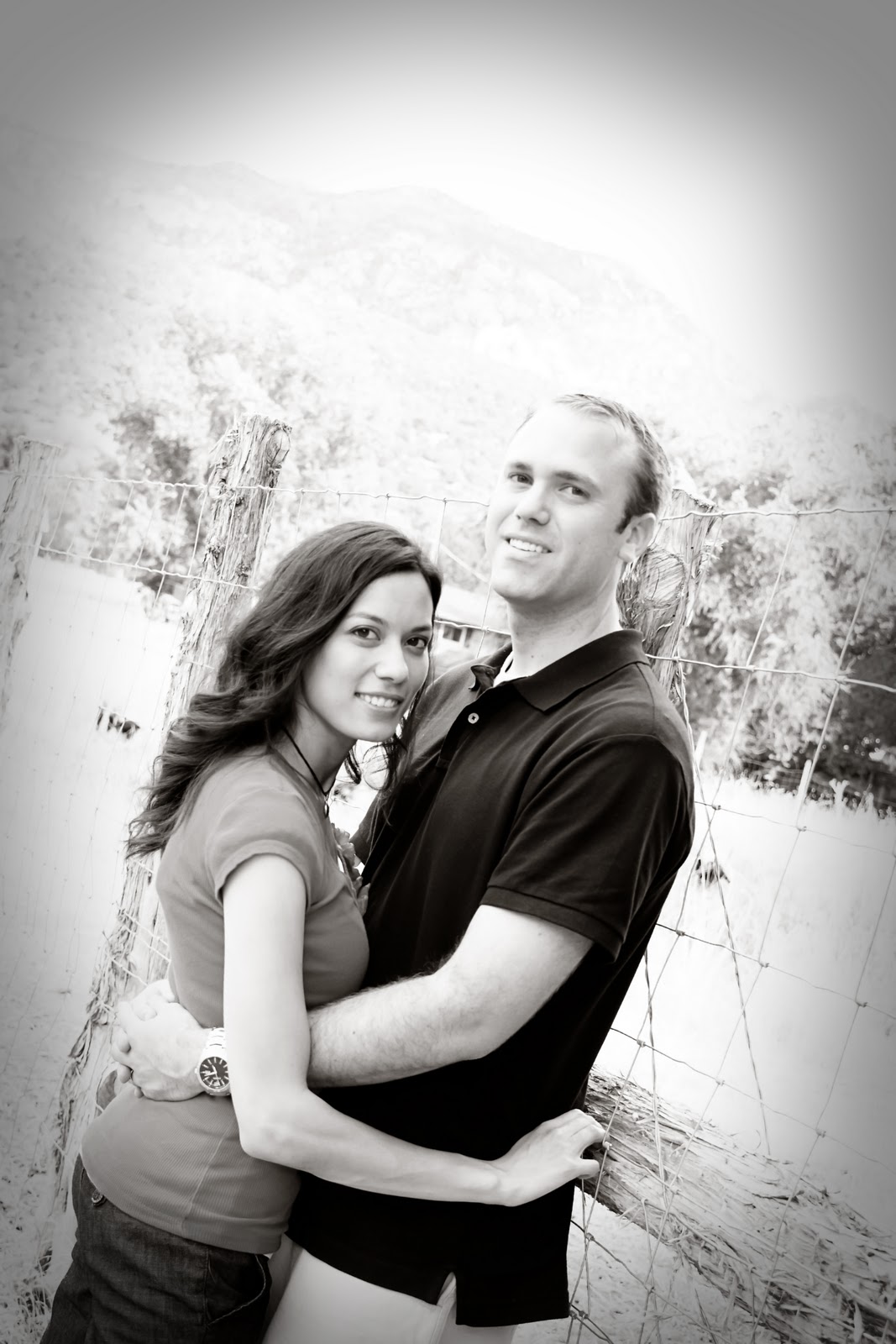
We had our pictures taken on July 30th while we were in Cedar City. It was all Jesse's idea. He tried hard to convince me that the following were good ideas: packing two separate outfits to wear while traipsing around the farm towns surrounding Cedar City, posing awkwardly for a stranger we had never met, but whose photos he had seen here andiwatkins.com (the maternity photos on this site inspired him to make an appointment with Andi). He may have been fooled by the website, but I was not.

Three hundred pictures of myself is the last thing I wanted. I tried to explain how awkward this would be, with closeups of kissing and walking into the sunset, but he insisted we do it. He finally sold me on the idea that the photos would commemorate our five-year anniversary. Although I hate getting my picture taken, how could I say no to that? So I finally gave in and tried to find an outfit that would coordinate with the colors he chose to wear.

The day our photos were scheduled to be taken, it rained. All afternoon. The rain only confirmed my initial suspicion that this was a bad idea. Oh, the things I do for him! He agreed that the photos will serve as birthday and Christmas gifts for the next five years.


This last one reminds me of the painting, American Gothic. Jesse wanted to bring props--overalls and pitch forks--and suggested I wear an apron and my hear in a slicked back bun, but I refused. Also, the sheep were being uncooperative and would not pose with us.

Saturday, October 2, 2010

Eviction Notice

This week I was “kicked out” of my classroom. I only teach two periods at Elk Ridge, and the teacher who’s been filling in the rest of my schedule has been teaching four periods in my classroom. We have enough seventh graders to give her two more classes. So a move of Machiavellian pragmatism was made to relocate me to a “portable.” These are classrooms outside of the school, lined up like one-room houses on the East side of the main building. They are divested of any technological equipment, they have regularly malfunctioning air conditioning and heating, and they have orange carpet and the lingering odor of wet dogs—at least mine does. I can see it now: For the rest of October, the room will be swelteringly hot, with kids slumped over their desks, half asleep; in December and January, we’ll all be huddling in a refrigerator, wearing our coats and gloves with icicles sticking to our snotty noses.

I was told last week to expect an official notification from the administrators. It never officially came. I knew it had to happen soon, and got tired of waiting for a definitive answer. I got suspicious on Thursday morning, the last day of parent-teacher conferences, and therefore the last day of the week because Friday would be teacher comp day. On Thursday, several of my students told me they would be switching out of my class and that I wouldn’t see them anymore. The counselors told them to expect their new schedule to take effect on Monday. On Monday! So when was someone planning on telling me?

This meant I would have to move out of my classroom and into the portable, and make it look presentable as soon as possible. I’m not sure how people expected me to magically move into my new room without coming in on Friday, or Saturday, or 5:00 AM on Monday. My solution? Skip out on parent-teacher conferences. At my designated table in the gym, I left a note for parents to come see me in the portable.

The portable’s previous inhabitant must have been a Spanish teacher, because an assortment of classroom furniture still bore laminated labels with Spanish phrases emblazoned over colors of the Mexican flag with sticky tape peeling off. So as a result of my relocation, I now know how to say “trash can” in Spanish.

Sunday, September 19, 2010

Timpanogos Hike

Last weekend, Joey and I hiked up to the top of Timpanogos. We started around10:00 pm or so on Friday night and didn't get back until around noon on Saturday. We slept for a few hours in the early morning in the permanent structure (not really a shack or a cabin) near the base of the mountain before climbing up to see the sunrise. It was a fairly grueling adventure but satisfying nonetheless.


Thursday, September 9, 2010

On Becoming a Teacher

During our graduate instructor training at BYU a few weeks ago, we were asked to respond to the writing prompt, "On becoming a teacher." So, here it is.


I got a head start on my career in elementary school. Merella and I filled our long summer days with school preparations. From Landon’s toy box we pilfered all the rectangular wooden blocks and turned them into desks for our Noah’s Ark hodgepodge of pupils—plastic cats and dogs from the “My Littlest Pet Shop” series, rubber ponies, porcelain horses and twin felt-covered zebras. When Dad brought home boxes of surplussed office supplies, we ransacked the stores for mini Post-it note pads and constructed books for each student. Merella made tiny art projects and U.S. maps out of squares of poster board to hang on the walls. I made little math work sheets with enumerations of times tables and 3-D models of the solar system out of Styrofoam beads and fine beading wire. We molded minuscule sandwiches and apples out of Sculpey clay, baked them in the oven, and painted them with layers of acrylic paint so each “kid” could eat lunch. Our students were impeccably well-behaved because their teachers believed in public humiliation as an effective form of classroom management. Anyone who misbehaved had to sit at the front of the room wearing a dunce cap made of construction paper.

When I grew out of this phase, I focused more on helping my dad get his real classroom at June Nelson Elementary School where he taught kindergarten. I put myself in charge of arranging the kitchen center and stacking books. I designed bulletin boards that inspired the envy of other teachers. The school of fish board was the best. On broad expanses of butcher paper from the teacher’s lounge I painted huge splashing waves. Jumping out of the waves were big cut-outs of orange fish—they looked like happy cartoon piranhas—with speech bubbles floating above their under bites that said “Welcome back to school!” Other teachers enlisted me to do their bulletin boards too. If I had had any sense, I could have turned it into a business.

By fifth grade, I felt I had my whole future planned. I would go to college and be a kindergarten teacher and my kids would bring me apples every day and I would live happily ever after with a yard full of cats. Then my teacher disrupted my simple paradigm of happiness. The class was asked to write essays about what we wanted to do with our lives. After she read mine, she made me stay after school. She said, “Sarita, do you realize you could be so much more than a teacher? You could be an artist or a brilliant heart surgeon! Don’t settle for teaching!”

Throughout this lecture on my poor choice of career, I thought, “Just because I did a report on the human heart in this class doesn’t mean I can be a surgeon. . .” and “After our impressionism unit in art and reading about all the starving artists who cut their ears off to send to old girlfriends, and who were disowned by their parents, I don’t want to paint landscapes with toothpicks and initiate a 20th century neo-pointalism revival for a living. But thank you for the advice.”

Nobody asked what I wanted to be when I grew up for a while after that. Until the summer before my senior year of high school. My family was visiting some friends we hadn’t seen since I was in elementary school. These family friends had both taught in elementary schools with my dad, and they had a son, whom I will call B— in case he turned out to be a blog stalker and discovers I still remember him. B-- was my age and was being groomed for Harvard medical school, which sounded so glamorous that I wanted to marry him right out of high school. During our visit, B—‘s dad asked me what my college plans were. “Not sure yet,” I said. I went through a phase where I wanted to be Miss Piggy’s costume designer. But in general, I didn’t know what I wanted. He looked me in the eye and said, “Sarita, if you become a teacher, I will never speak to you again.”

“Okay,” I said.
“You know what I always told B--?”
“No.”
“I told him, son, you have to dream BIG. And now he’s going to be a doctor.”
“That’s great…” I said.

My parents were never worried about me. They guessed I’d figure it out someday. I have to admit that B--'s dad's comment made me want to reconsider. Why? I don't know. I should have ignored it. But it made me pay more attention to my teachers when I returned for senior year in the fall. I noted all the teachers who lost control of their classes or who might have stirred from their desks and let go of their coffee cups if the classroom had gone up in flames. I saw the flaws in teachers who assigned "read-the-chapter-silently-and-answer-the-questions-at-the-end-and-be-ready-for-a- test-on-chapters-1-10-tomorrow" assignments every week. I internally criticized the "teachers" who let us watch movies every Friday. It was uninspiring. My teaching ambitions were lost in the Ether.

I read A Farewell to Arms right around the time I thought about writing my college application essays. The nurse Catherine Barkley made nursing sound romantic. I began to like the idea of nursing, beyond the idea of Catherine Barkley. So I went through another phase. I wrote about nursing on all my college application essays.

I took chemistry 101 my first semester at BYU, since this class was a prerequisite for the nursing program. I hated it. I wanted to burn the textbook every day after class. And then I realized that this did not bode well for a prospective nurse, and that I really didn’t like needles and bed pans and hospitals anyway. So I switched to “open major.” The career aptitude tests I took at the BYU Student Services Center didn't help either. They all indicated that I demonstrated aptitude in wine tasting, the arts of the environmental standards technician (euphemism for garbage collector), and teaching.

“Teaching it is,” I thought. Eventually I did all the paperwork to change my major to English composite teaching mid-way through my sophomore year. English composite teaching supposedly prepared one to teach English using music, art, and history. Immediately after I had enrolled in the prerequisite courses, and had gone to class for several weeks, the major was discontinued. English teaching was the new backup plan.

I chose English teaching after sitting in my apartment, staring out at the rain drizzling the window panes, thinking in the voice of the armless cartoon character, “Homestar Runner” who breaks down one day and wails, “I don’t know what I’m doing with my life!” The rain outside reminded me of a rainy afternoon I had spent in the house, when I was in high school, curling up on the couch to read C.S. Lewis’s The Screwtape Letters. My dad walked into the living room and found me annotating the pages furiously, saw the ragged edges of neon-colored sticky notes creeping out of the top of the book and said, “You want to be a high school English teacher, don’t you?”

Then I remembered how I never took any high school English classes. Instead I took writing classes from a local branch campus of the University of Alaska-Fairbanks. Some obscure world literature classes on the side. But I missed out on all the classics normal students at any other high school would have read. I decided to compensate for this gaping lacuna in my education by reading as many books as possible from the “College Bound Reading List" in the last two summers before high school graduation.

I spent summer afternoons with Austen’s Pride and Prejudice and the voluminous tomes of the British Victorian period that distinguish one in the masochistic reader's hall of fame —Jane Eyre, Tess of the D’Urbervilles, and Wuthering Heights. I read Hemingway’s The Old Man and the Sea, and For Whom the Bell Tolls during slow evening shifts of waitressing. When school started again, To Kill a Mockingbird and Animal Farm were some of my constant companions during the cross country running season when we flew to compete in all our meets. And in twelfth grade I propped my science textbook on my desk and pretended to be extrapolating the number of lichen bushes on the broad expanse of Kotzebue's tundra regions based on a 12 x 12 foot sample. Instead I was reading The Catcher in the Rye...

So there I was sitting in my apartment staring out the window, and wondering why I hadn’t started out as an English major in the first place. It made sense to major in English teaching. I loved education and reading, writing, and helping others. So I changed my major one last time and dreamed of being the woman version of John Keating in The Dead Poet’s Society--but without my students calling me "O Captain, my captain."

And then I got my first teaching job. Seventh Grade English. So not what I had envisioned. It was even better.

***

I have a folder in a filing cabinet at home. The folder has gotten a little fatter every year. It’s filled with thank-you notes from students. Some of the notes say, “Thanks for not giving us boring old grammar worksheets!” or “I never knew English could be fun,” or “You’re my favorite teacher because you never yell at us!” or “I come in your class and feel like my day is going to be okay.” Some of the notes are from straight A students who love English anyway. But the ones that surprise me are from the kids who sat through class all year, raising their hand only to ask if they could go to the bathroom in the middle of a lesson.

One of these thank you notes I will always remember. It was from a ninth grader at Lehi Junior High. He never talked in class. (The most I had heard him speak at one time was when he played the role of Juliet in his group’s red-neck rendition of the balcony scene.) Yet he managed to fill both the insides of a folded card and had more to say than I would have thought possible. I never considered graduate school until after I read his card, remembering how much I wished I could teach his class in high school, and how a master’s degree might have made me a more marketable candidate.

Middle school kids amaze me every year. I wouldn’t go back to age 13, or 14 or 15 for anything. So I often wonder why I continue to surround myself with this age group. I suppose it’s because I know that at their age, their job is to get through the day without doing anything embarrassing, and if they have a secret, everyone knows, and as Laurie Halse Anderson says in Speak, one of my favorite books, “It’s easier to floss with barbed wire than to admit you like someone in middle school.” I like middle school kids because in the midst of all the newfound glories of puberty and sitting through sex ed and the terror of showering after P.E. or being ostracized for wearing the wrong shoes, they still have the decency to say “thank you.”

Thursday, August 19, 2010

The important thing about Jesse

This is the obligatory anniversary post. A bit belated, but that's how I do everything these days.

When I was in elementary school my grandma gave me The Important Book by Margaret Wise Brown, author of Goodnight Moon for Christmas. It was published in 1949. I thought it was about as thrilling as going to the dentist, but that's because I had no imagination and a limited tolerance for things that looked deceptively boring. Years later I discovered that it's a useful model text for secondary language arts teachers because it follows a specific pattern that students can imitate, yet personalize in interesting ways. The author describes the important things about a variety of items found in nature. Every page starts and ends with, "The important thing about _______, is _______. In between the first and last two sentences are descriptive details. For example, here's what she says about snow:

The important thing about snow is that it is white. It is cold, and light, it falls softly out of the sky, it is bright, and the shape of tiny stars, and crystals. It is always cold. And it melts. But the important thing about snow is that it is white.

If Jesse were a page in this book, here's what it would say:


The important thing about Jesse is that he picked me.

He thinks I look nice even when I exhibit swine-flu like symptoms, and he will still let me back in the house when I return from the salon with a haircut that looks like I did it myself with my eyes closed.

He doesn't care if I bowl 10 gutter balls in a row at the bowling alley, and he can do fractions without a calculator.


Jesse looks like a man, and smells like a man.

And he does t
he laundry.

But the important thing about Jesse is that he picked me.


August 17, 2005, Salt Lake City

Wednesday, August 18, 2010

This is the place!

I can die happy now that I've been to This is the Place Heritage Park. We went for the Rich family reunion a few weeks ago. If you haven't been yet, I highly recommend it for the eye-opening experience and the likelihood that it will instill feelings of gratitude for modern technological advances. As I walked through Old Deseret Village with its restored pioneer buildings and houses, I had an epiphany: I might have made a half-way decent pioneer!

Living in Alaska was like being a pioneer. Sort of.

For one thing, I didn't see any toilets in the replica homes. The word toilet probably did not enter my vocabulary until I was five. Yet somehow I remember hearing stories about being an extrinsically motivated potty trainer. I was bribed with sweets. So maybe I had a toilet while my parents didn't. Fortunately, I was too young to remember those halcyon days without indoor plumbing. I have no recollection whatsoever of the "honey bucket," a crude sort of chamber pot with ten times the storage capacity. Wikipedia's entry on the honey bucket says the following: "The honey bucket sits under a wooden frame affixed with a toilet seat lid. These [buckets] are often the same type of plastic five–gallon (19 liter) buckets used for shipping many paints, cleaners, and solvents, as well as institutional quantities of food products" (emphasis mine). So naturally, a few questions arise in my mind: where did my parents keep said honey bucket? How often was it emptied, and where? I suppose the only honey bucket related memory I have is when I was a junior in high school and went on a cross country running trip to the village of Buckland. Our team was instructed to give the big red dumpster on the side of the trail a wide berth because it was filled with you know what. That was in 2001.

Okay, moving on.

Before age five, I lived in a 16 x 24-foot plywood shack, raised several feet off the ground, like all the other houses, on a hill overlooking the spruce-lined banks of the river in a village called Noatak (Noah-tack) with the Baird Mountains rising behind the trees. There were maybe two rooms. One of them was a bedroom with a home-made bed of my dad's own Posturepedic design. It consisted of layers of thick foam atop an arrangement of mismatched oil drums; some stood higher than others and created a lumpy, uneven sleeping surface (same concept as the returned missionary sleeping on top of his food storage in The RM). In this room we often woke up with the blankets frosted to the walls after the temperature dipped to -60 in the winter.

The second room doubled as a space for everything else. It was a room filled with the smells of diced caribou flanks frying in garlic or baked chum salmon, or the mozzarella cheese sandwiches with salsa on 12-grain bread my dad ate when he came home for lunch. It held the water supply, hauled by my dad in five-gallon buckets (water buckets, not honey buckets) up the hill from the Noatak River; the buckets sat in a corner while the gray river silt settled at the bottom before the water was boiled for cooking, drinking, and bathing. And speaking bathing, my sister and I took turns getting pots of warm water dumped over us while we sat in large plastic Rubbermaid tubs. It held an oil drum woodstove around which clothes wet socks, mittens, and hats were hung to dry after getting soaked in knee-deep snow during snow machine excursions. It held a dilapidated couch draped in the fur of a brown bear shot by my dad in his bachelor days. It was filled with drawings, since Merella and I were allowed to color on the walls, and I used the space to practice writing my name. Before the shack was torn down I imagine one could have found crayon murals of purple moose and pink princesses intermingled with inventive phonetic preschool spellings of "Sarita" streamed across the walls. The second room also held boxes of Harry and David's pears shipped from Conway, New Hampshire, close to where my grandparents lived--they sent packages of fruit regularly to make my immigrated Filipino mom feel "more at home." A kind gesture that I doubt compensated for the lack of a toilet and a real kitchen.

Noatak was a town where you had to wait in line at the post office to make your phone calls and where the mail came on a plane (along with everything else in the village) a few times each month, and where you could find porcupines nesting under your house. It was the good life for sure.

Secondly, I used to "make my own clothes."
Sometimes. My mom got a sewing machine for a wedding gift and figured out how to use it all by herself. She made us itchy wool pants that chafed every square inch of skin they touched, fur hats, parkas, dresses for school. For my dad she made button-up shirts of the most vibrant tropical floral prints that suited her taste.

I didn't touch a sewing machine until I was in ninth grade. The first thing I recall making was a dress for an Anne of Green Gables doll. It took about a week to make and by the time I was finished, I decided I was ready to retire from my brief career as a seamstress. I took the easy way out and made all the rest of my doll clothes with a glue gun instead.

I took up sewing again in the months of April and May for the next three years. These months were filled with prom preparations and I refused to be caught wearing the same dress as someone else. This devastating tragedy happened to several of my friends. I was not interested in spending several hundred dollars on a dress that would be worn once and trailed through the mud and residual snow of May to get to the sparsely decorated high school gym. I made do with what I had at home--a story for another time. I estimate my total cost of attire for four proms to be under $15. Given my gifted nature when it comes to spending money, this is a miraculous figure. All it took were some beads and some ibuprofen to ease the backaches I acquired while bending for hours over the fabric of my dresses with needle and thread poised between my fingers. I cannot explain these bouts of irrationality I suffered every April and May. Any sane person would have just mail-ordered their dress over the Internet like everyone else...

Outside the General Store. Inside you can buy faux racoon fur hats, which reminded me of the one my mom made for my brother when he was in kindergarten. He wore it with a bright blue snowsuit until the tail fell off. Inside the General Store you can also buy candy called chipmunk and rattlesnake poop. The rattlesnake poop was more expensive. Then we saw "Bella Swan" whose appearance was much improved by a taxidermist.


One of 700 pictures we took somewhere in Old Deseret Village.

We went into a hotel that smelled like toothpaste and bacon but had an ice cream shop annexed on the side. We looked at the menu and saw flavors such as burnt almond fudge, cookie dough, mint chocolate chip, and play dough. Unlike every other ice cream shop in the United States, this one did not offer free samples, so I had to trust the boys behind the counter who promised that the ice cream only looked like play dough and did not taste like play dough. They said it tasted like bananas or Skittles. So I had to take their word for it. It tasted peachy.


We then took our ice cream into the building where the pioneers printed their newspaper. Each building in Old Deseret has one or more people dressed in pioneers supposedly "in character." "In character" for most of them just means that they are simply dressed in pioneer clothes. But the man in the print shop appeared to be stuck in the 1800s, because when asked a simple question that required one straight answer, "How long does it take to print the newspaper?" he proceeded to detail the differences between the pioneers and the Israelites based on the fact that one group had a newspaper and the other did not, while referring to the pioneers with first person pronouns. When it was clear that our question was not going to be answered, we backed away slowly toward the door and left.

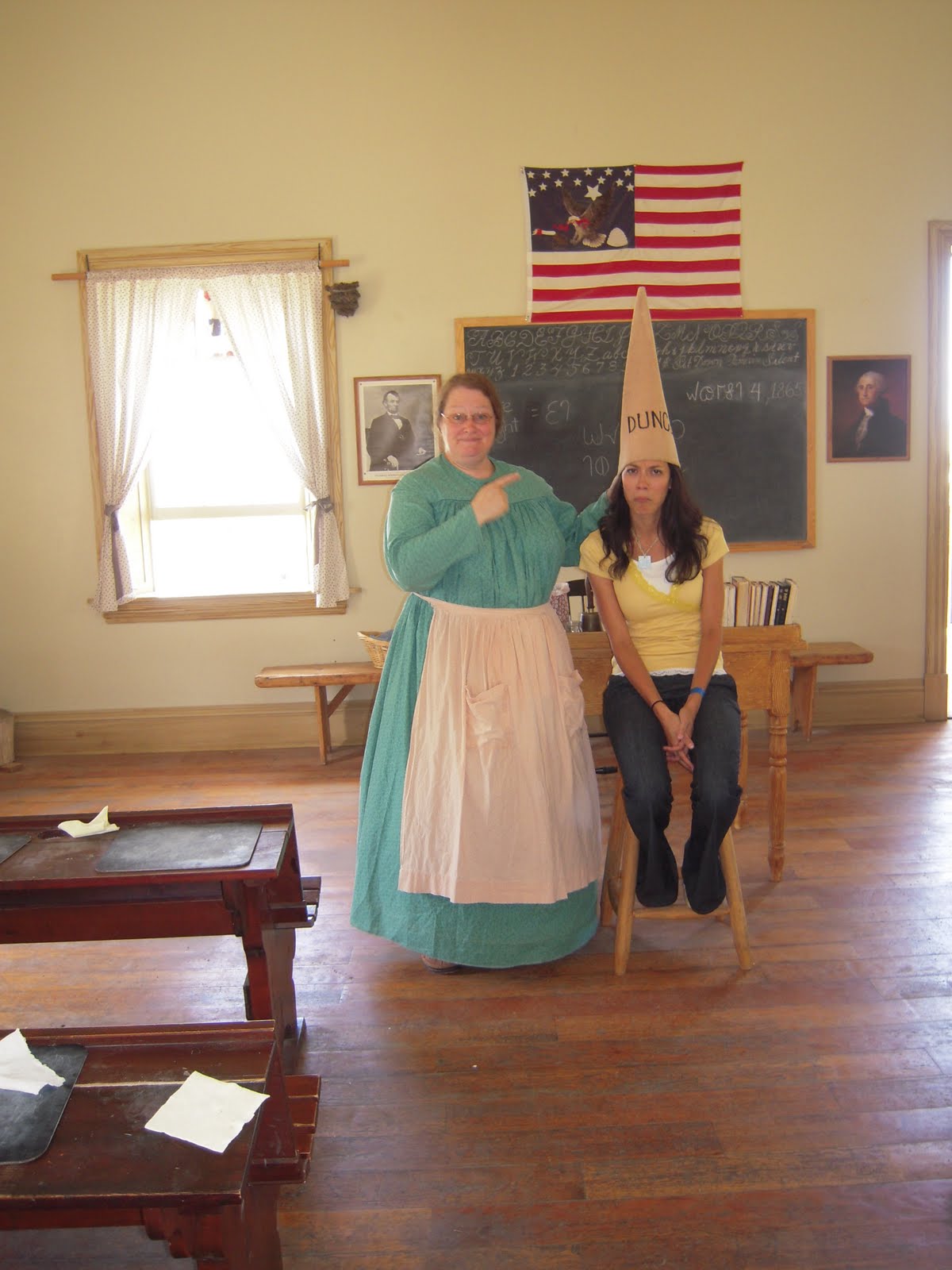
How could I resist the schoolhouse? The "pioneer" hostess who gave her lecture on the life of school children included a lesson on the Deseret Alphabet--which is harder to read than it looks. We were also informed of punishments naughty children had to endure, including standing with their noses touching the wall and their arms stretched out behind them holding several pounds of books in each hand, and sitting on a stool in front of everyone wearing a dunce cap. And if they were really naughty, they had to bend over for spankings with a wooden paddle. Volunteers were singled out to demonstrate each of these punishments, and since me, Jesse, Barbara and Charles were pretty much the only ones in the room, we were asked to volunteer for everything--including the spanking. That last one was kind of awkward.